
Real Time Translator|Case Studies Pharmaceutical Industry Tanabe Pharma Corporation
Accelerating Decision-Making and Enhancing Global Communication with Real Time Translator
COMPANY PROFILE
- Industry:
- Pharmaceutical Industry
- No. of employees:
- 4,490 (Consolidated)
Tanabe Pharma Corporation (formerly Mitsubishi Tanabe Pharma Corporation), founded in 1678, is one of Japan’s most established pharmaceutical companies. The company focuses on the research, manufacture, and sale of prescription pharmaceuticals.
As part of its global expansion strategy, Tanabe Pharma utilizes Real Time Translator during online meetings with overseas group companies and international partners. The solution is also deployed as a communication support tool for employees with hearing impairments.
By enabling real-time transcription and translation, Real Time Translator has accelerated decision-making and significantly improved operational efficiency across the organization.
Below, we share insights from our interview regarding the background, implementation process, and ongoing utilization of Real Time Translator.
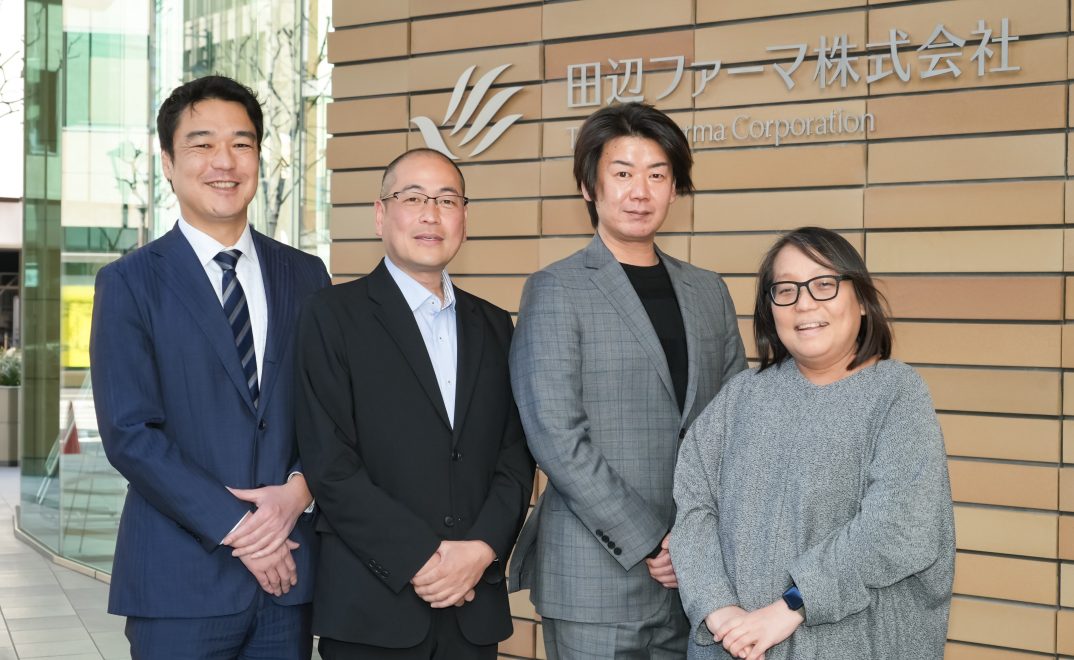
Start of Real Time Translator use: September 2021
Interview Conducted: April 2025
Interview Participants

BT-S&M/PS/QV Group
IT Digital Department
IT Digital Division

Director
Infrastructure & Collaboration Group
IT Digital Department
IT Digital Division

Infrastructure & Collaboration Group
IT Digital Department
IT Digital Division
Table of Contents
Company Overview and Background
Could you briefly introduce your business?
Tanabe Pharma Corporation is engaged primarily in the manufacture and sale of prescription pharmaceuticals. (https://www.tanabe-pharma.com/ja/company/outline.html)
Founded in 1678, the company is headquartered in Doshomachi, Osaka — the birthplace of Japan’s pharmaceutical industry. As one of Japan’s most historic pharmaceutical companies, Tanabe Pharma operates under its mission “Creating hope for all facing illness,” To fulfill this mission, the company focuses on therapeutic areas including:
・Central nervous system disorders
・Immunology and inflammation
・Diabetes and renal diseases
・Oncology
Through its pharmaceutical innovations, Tanabe Pharma contributes to improving the quality of life (QOL) of patients and their families worldwide.
What was the purpose of introducing Real Time Translator?
- As a global enterprise, the company regularly conducts online meetings with overseas group companies and international partners.
- Improving mutual understanding—even slightly—helps mitigate risks such as project delays.
- The tool is also deployed as a communication support solution for employees with hearing impairments.
Hearing impairment does not simply mean reduced hearing ability. Some individuals may not perceive spoken language in the same way. While lip-reading can provide limited assistance, it has clear constraints.
In today’s environment, where online meetings have become the norm, important information may be conveyed verbally outside of shared presentation materials. This creates a risk of misunderstandings that could lead to incorrect decisions. Real Time Translator helps mitigate these risks by providing real-time transcription and translation.
Challenges Before Implementation
What challenges did you face prior to implementation?
There was a significant gap between employees who could understand English and those who could not. This created information asymmetry during meetings.
Many participants were unable to ask questions in real time and instead relied on post-meeting minutes or follow-up communication. This resulted in time loss and delayed decision-making.
Were there any concerns before introducing the solution?
There were concerns regarding whether Real Time Translator would be practical in real-world operations, as transcription and translation accuracy was estimated at approximately 70%~80%.
Why did you choose Fairuse Inc.’s Real Time Translator?
- It is not limited to specific online meeting platforms such as Teams, Zoom, or Webex; any audio played through a Windows PC speaker can be transcribed.
- Transcription and translation accuracy at the 70%~80% level was deemed sufficient for operational use.
- The service is provided as a SaaS cloud-based package with fast and responsive support.
- It supports a wide range of languages.
- New features are added quickly and continuously.
- Logs are stored locally on individual PCs, reducing the risk of server-based information leakage.
- Transcription and translation data are not reused for secondary purposes such as deep learning retraining.
Implementation and Usage
In what situations is Real Time Translator currently used?
- Primarily during online meetings with overseas counterparts.
- For employees with hearing impairments, Real Time Translator is also used in face-to-face settings by directing a microphone toward the speaker to generate real-time transcription.
What aspects have you found particularly convenient?
- Improved communication and mutual understanding during meetings.
- The ability to generate a web URL and share the live transcription and translation screen with other participants.
Were there any unexpected benefits?
- The logging function allows users to review past meetings, and the summary feature enables quick understanding of meeting overviews. These logs are also valuable for knowledge transfer to successors.
- By eliminating the need for interpreters and using Real Time Translator for both Japanese → English and English → Japanese communication, meeting durations were frequently reduced by 15~20 minutes. This practice is now used consistently.
Results and Impact After Implementation
What changes did you observe in internal communication?
With real-time transcription and translation, employees can ask questions immediately during meetings. This has significantly accelerated decision-making.
How Real Time Translator impact work efficiency and ease of working?
As noted above, the tool improved operational efficiency and communication by enabling immediate comprehension and interaction.
Has there been a positive impact on the business overall?
Yes. The acceleration of decision-making has had a clear and measurable positive impact across the organization.
Future Outlook and Expectations
How do you plan to use Real Time Translator in the future?
The company is considering expanding its use to communication with overseas group companies in non-English-speaking regions.
What do you expect from Fairuse Inc. regarding Real Time Translator?
- Development of a smartphone application version
- Addition of a text-to-speech (read-aloud) function
- Faster translation output for long sentences by delivering results in shorter segments
- Faster language switching (Japanese → English and English → Japanese) and, ideally, speaker-specific voice recognition
Supplementary Notes from Fairuse Inc. (Added in January 2026)
Regarding point 3:
On April 27, 2024, Fairuse released the Boost Translation Feature for Real Time Translator, enabling incremental translation at the word or phrase level.
Feature details:
https://fairuse.jp/real-time-translator/basic-feature/#basic-feature-2
Regarding point 4:
On April 26, 2025, Fairuse released the Automatic Language Identification Feature for Real Time Translator, enabling automatic language detection by speaker in multilingual meetings.
Feature details:
https://fairuse.jp/real-time-translator/ai-feature/#anc1
Could you advice for other companies considering Real Time Translator?
- Real Time Translator should be adopted with the understanding that transcription and translation accuracy is around 70%~80%. Expecting 100% accuracy may lead to unrealistic expectations. Even at this level, Real Time Translator is highly effective for meetings.
- Prompt and attentive support, with quick resolution times, is also one of its major advantages.